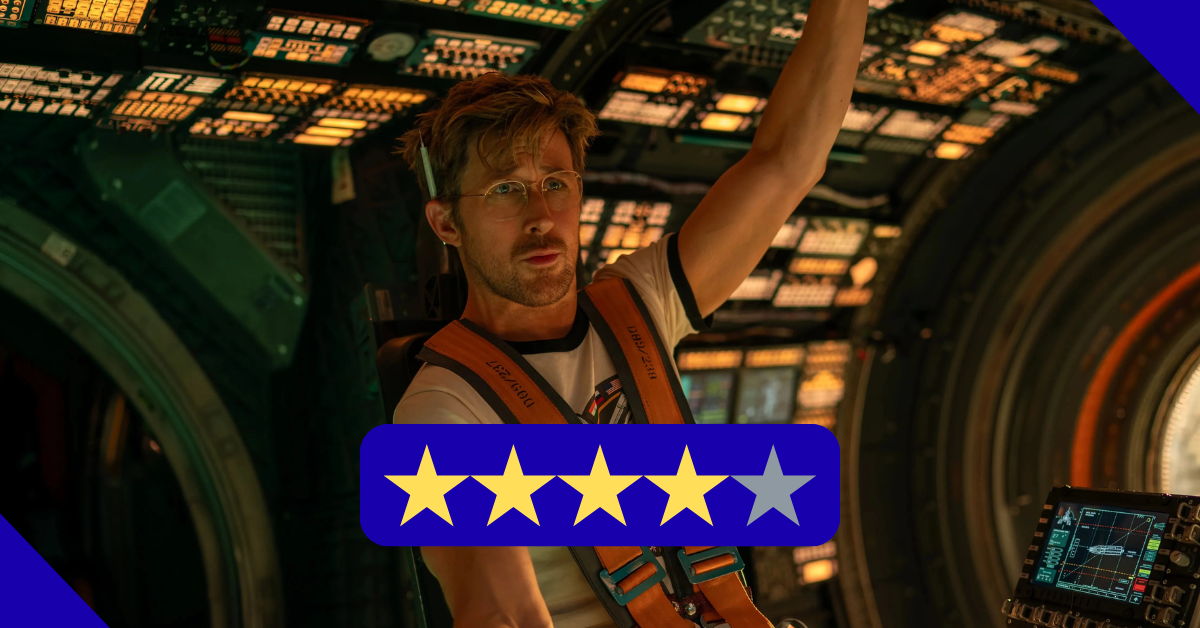
Finally, a movie for neurodivergent folks who pull their glasses off halfway and leave them for extended periods of time. Project Hail Mary is finally here, once again trying to take an aggressively dorky Andy Weir hard sci-fi novel and make it a watchable movie. In many ways, Project Hail Mary proves more difficult a book to make into an entertaining movie than The Martian.
Did Phil Lord and Christopher Miller pull it off with a Drew Goddard screenplay?
Mostly!
What is Project Hail Mary?

Both the book and the movie kick off the same way: microbiologist Ryland Grace (Ryan Gosling) awakes in a strange place to find he’s been in a medically-induced coma for some time. Electrodes on his skin have stimulated his muscles, leaving him jacked and well-fed. He soon comes to find he’s alone on a spaceship and experiencing intense amnesia.
From here the book and the movie deviate significantly. The book spends a lot of time establishing the stakes of Grace’s mission before dropping in the actual thrust of the story: Ryland meets an alien on the same mission as him, and they have to learn to communicate.
The antagonist of Project Hail Mary is simple yet nerdy: effectively interstellar algae has infested our solar system, bouncing between the sun and Venus. The more of it breeds, the dimmer the sun gets as they absorb its energy. Humanity needs to figure out how to stop the algae (dubbed ‘astrophage’) before the sun dims so much life is unsustainable on Earth. Hence the title of the movie, and the eponymous ship Grace wakes up on.
What About the Cast?

There are three characters you have to nail to have any chance of making Project Hail Mary work: Dr. Grace, Rocky, and Dr. Stratt.
Eva Stratt is a tricky character to nail. In the book she’s a German scientist who finds herself in charge of a program with functionally unlimited resources: Project Hail Mary. Laws and limitations mean nothing to her, as she’s the person the world’s governments have agreed to run the organization that’ll save the human race. Regularly in the book we get to see her be borderline robotic in the hard decisions she has to make for the survival of the human race.
Sandra Hüller does an excellent job playing Dr. Stratt in the movie version. That said, I only really appreciate the gravitas of her performance because I’ve read the book. The movie itself never really makes it clear just how much power she has or what she’s doing. Without spoiling anything significant: book-Stratt operates fully under the idea that the second the Hail Mary leaves the solar system and the long wait for answers begins, she’ll be immediately jailed by countries she upset by abusing her power. Movie-Stratt never really gets the runway to establish this.
Then there’s Rocky, the five-legged rock creature Dr. Grace finds once he arrives in the alien solar system. Rocky’s from an advanced alien race who has figured out certain levels of science to astounding degrees (such as using xenon gas to make a solid construction material) but woefully underprepared in others. By virtue of not having eyes, Eridians like Rocky have no concept of things like relativity or radiation. They never had to figure out things like photons or the speed of light.
Project Hail Mary lives and dies by how personable the crew can make Rocky, and they nailed it. He’s such an expressive little dude. He speaks a melodic note-based language that’s translated with several computers duct-taped together to create a crude translation machine, voiced by lead Rocky puppeteer James Ortiz.
Practical effects are a huge part of the philosophy behind the movie and it shows. This might be some of the best zero-gravity acting work and effects I’ve seen yet. A shame a significant amount of the movie invents reasons for the sets to have gravity.
How is the adaptation?

I don’t feel like writing a dissertation on the differences between the movie and the book. What I will say is most of the decisions made to change or omit things from the book are for the better. To the point, sometimes, it feels like Goddard acts as a Mystery Science Theater 3000 riffer to the book because he figured out a much more elegant solution to something that required multiple chapters and flashbacks in the book for Weir to twist himself into knots before solving.
That said, there are some differences that make it feel like an incomplete movie if you haven’t read the book. A pretty significant third-act development in the plot is condensed down so that instead of being a significant impediment to Dr. Grace, it’s a slight speedbump on the way to the fast-approaching ending. Some pretty important science is done off-camera and only referenced after the fact, as if the audience wasn’t paying attention in an earlier scene. To the point I suspect there might have been a deleted scene that set things up better but we chose to excise it in favor of more footage of Dr. Grace and Rocky hanging out in the invented-for-the-movie video projection room watching Storyblocks footage of Earth.
Several emotionally-heavy moments in the book are hand-waved away in the interest of speeding things up. Ironic, given the movie drags with a 2.5 hour runtime that begs to be closer to 2 hours. Such is the challenge of converting a book into a movie. It just comes to a point where it almost feels like Amazon is begrudgingly making it a movie instead of an eight-episode miniseries destined for Prime Video.
Is it Worth Seeing?
Absolutely! Gosling does a solid job embodying the dweeb science teacher that is Ryland Grace, Rocky is fun as hell, and the Hail Mary itself is a banger ship. My only real beef with the sci-fi parts of this sci-fi movie is we don’t get as much dicking around with the ship as happens in the book. An eternal problem with spaceship books being turned into movies, though.
A tad long, but a heck of a fun time regardless of whether you’re new to the story or a book fan curious to see how they pulled it off.



Leave a Reply