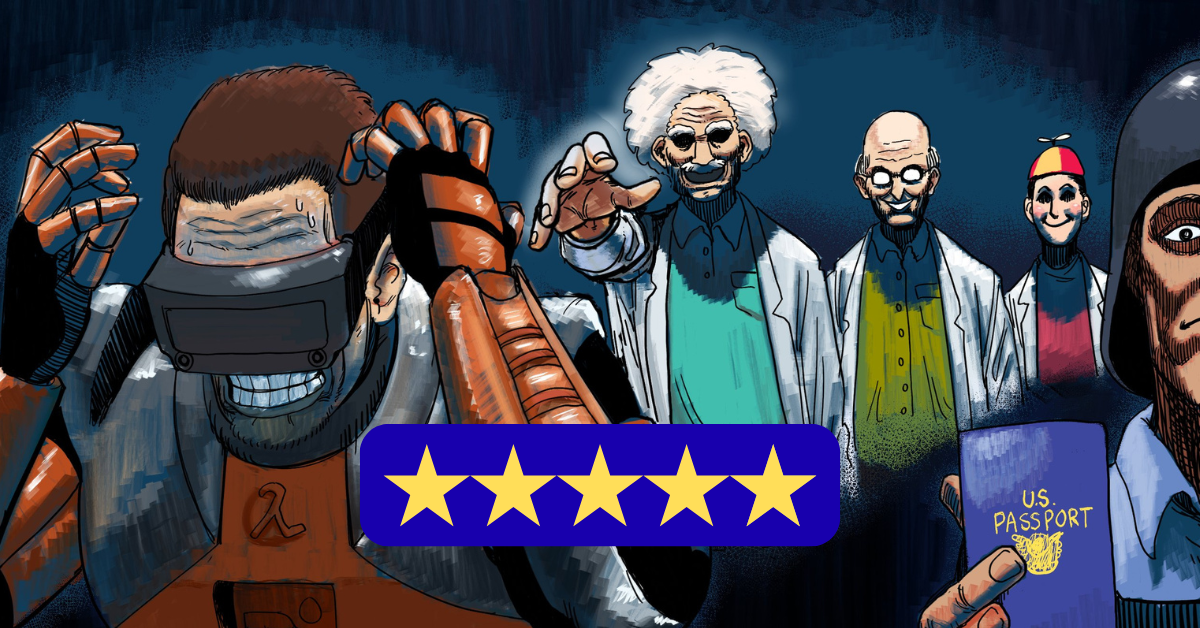
Six years ago this month the first installment of the video game machinima improv comedy series Half-Life VR but the AI is Self-Aware uploaded to YouTube. Published during the height of Covid-19 lockdown, Half-Life VR but the AI is Self-Aware (HLVRAI) endeared itself to millions who found themselves stuck indoors looking for new art.
Since then the crew behind the series has found great success with follow-ups and spiritual successor projects. As of this writing the first fully-edited episode of Half-Life 2 VR but the AI is Self-Aware is slated to release today. With such a momentous occasion upon us, I feel duty-bound to tell people about the magic that is the original series.
What is HLVRAI?

In-canon the premise of HLVRAI is easy: streamer WayneRadioTV is streaming himself playing a “rare beta version” of the Valve first-person shooter Half-Life. This fictitious beta comes with native virtual reality helmet support and “experimental AI features.” Early in the game he picks up Benrey (Scorpy), Tommy (Baaulp), Dr. Coomer (Holly hollow_tones), and Dr. Bubby (MasterGir).
The early episodes of HLVRAI are unpolished in a delightful way. This is not some highly-tuned professional production that can rest on its laurels, confident it will succeed. For a good portion of the series standard WayneRadioTV animated pop-ups indicating someone subscribed or donated money to his channel appear on screen. In the lower left you can watch chat (mostly) play along as if the “AI” NPCs are actually in the game.
Holly in particular is easy to play along with, as she has a pitch-perfect impression of fan-favorite Half-Life scientists Dr. Coomer. She also commits to the AI bit far more than other cast members, portraying Coomer as an NPC that oscillates between classic well-known bits of dialog (e.g., “Hello, Gordon!”) and self-aware dialog commentating on the situation. Oftentimes she’ll interrupt herself to make her voice sound like it’s glitching as two different pre-recorded bits of dialog intercept each other. An effect enhanced by the fact cast members are intentionally using in-game chat to make their mic feeds sound as compressed as Half-Life’s original voice acting.
Meanwhile Scorpy’s character Benrey serves as antimatter to Wayne taking things too seriously. In just about every scene there will be at least one instance of Scorpy injecting himself into a conversation to become a roadblock. In improv slang, he embodies “No, but.” Benrey as a character is inherently antagonistic to Wayne’s version of Gordon Freeman but for the least-justifiable reasons. Enough to make Wayne’s frequent shouting and frustrated sighs feel 100% genuine.
How did they do it?

In practice, there’s so many moving parts. Wayne is actually playing a session of Garry’s Mod, a popular mod-turned-game built in Valve’s Source engine. This setup enables two vital concepts:
1. Players in the same server as Wayne can load in levels from Half-Life where he can pretend to play through the game as-normal.
2. Players have near-infinite creative possibilities at their fingertips, as they’re playing a game designed to build or modify contraptions instead of simply being additional players in a cooperative session of Half-Life.
Wayne isn’t just running through Half-Life while his streaming compatriots pretend to be scientists from the game’s story. He’s wandering through levels of the game where, whenever his back is turned, those players can phase through walls, spawn other NPCs, produce a rocket launcher, or a thousand other impossible actions.
Effectively, Wayne is a living camera through which the audience experiences a live, improvised play loosely fitting into the guise of being a ‘normal’ playthrough of Half-Life. Until it doesn’t. Then it very much doesn’t as things get more customized near the end of the story. Ending in a grand presentation that, somehow, ties all the improvised plot together into a satisfactory ending.
All of which is reinforced by the way most people experienced HLVRAI: edited videos. While there’s a magic to experiencing an improvised production from the Radio TV Solutions (RTVS) crew (the formal name of the streamer group founded by Wayne), post-production adds such character and legibility to what otherwise can be a hot mess. The YouTube versions of the stream uploaded to WayneRadioTV’s main channel condense large sections of the stream into tight 25 minute episodes with burned-in subtitles. Each NPC character has animated subtitles (each with their own unique font and color assigned so you always know who is talking) that put fan-subtitled anime to shame.
All told the official HLVRAI playlist caps out at around 5 hours of edited content spread over nine videos. For the super-fan, the full cast commentary executed over several streams runs over 13 hours total.
What makes HLVRAI special?

The series starts strong and refuses to stop. Within sixty seconds Scorpy cracks a joke that will define several hours of every participants’ lives. Of course, nobody knows that because the majority of the cast and crew are making it up as they go along. Consider figuring out which one it is your homework while watching the first act.
The tone of HLVRAI is, in a word, manic. Wayne represents a train barreling ahead at all times while the rest of the crew frantically try to build a new track in front of him before he falls off. Even when they fail spectacularly, somebody somewhere throws a single rail out that catches Wayne and guides him back to where he needs to go.
Some of this is editing magic, with the heavily-edited 25 minute chunks massaging the narrative on occasion (as detailed in the excellent commentary stream recordings). But a significant majority of the saves come from what makes every successful RTVS project special: performers who can match each other’s freak while being wildly different people.
We’ve all encountered content creators who collaborate with people who are too similar. Podcasts where two dudes just agree with each other for an hour. Videos where people review food and have nothing of substance to say. The RTVS crew are the kind of friend group that are dangerously close to having accidentally built a conlang because they can communicate exclusively in vocal stims and in-jokes if they really wanted to. Many of the non-sequitur jokes throughout HLVRAI are sourced from a bit of hyper-niche internet culture or verbal slipup that only people in the crew were present for.
Few things online are as quotable as HLVRAI. In act 1, part 2 Baaulp has to justify why Tommy casually walked in front of the firing line of a turret that nearly killed Wayne. Which leads to the following exchange:
Tommy: The turrets can’t hurt you, it’s part of our… turret-ing test. It can’t hurt you if you’re smart. That’s why we’re all scientists.
Wayne: Buddy. Buddy. Buddy…That’s not how that works. I need you to preserve yourself.
Where to go next.
The good news is, even if you burn through the entire cast commentary for HLVRAI, you’ve got plenty more where that came from. In 2021 Wayne did a semi-sequel in the form of a Half-Life Alyx playthrough under the premise he would do the gnome achievement (carrying an in-game prop from the beginning to the end of the game, a recurring achievement in Half-Life games) with a special mod to make the gnome self-aware.
Of course, this was an RTVS production with similar levels of off-camera trickery. While not as many NPCs are involved, the gnome in question is incredibly vocal as multiple RTVS crew members furiously type prompts into now-defunct voice clone AI UberDuck to make the gnome’s voice respond to Wayne live. The gnome adventure captures some of the original series’ spirit and definitely has the same bonkers, occasionally baffling sense of humor, even if it is more limited in scope.
For more of the same manic “we’re putting on a show” vibe, there’s the entirety of Breaking Bad retold as a VR game, a three-hour epic in which the RTVS crew loosely improvises the plot of the series Breaking Bad in a custom Garry’s Mod map. Or the GameClam conferences; semi-annual fake E3 presentations in which Wayne plays the CEO of a fictional gaming company who keeps putting out increasingly obtuse consoles (and announcing baffling games for them) each year.
While Bo Burnham’s Inside provided cathartic expression of living in a lockdown world, HLVRAI served as an almost dadaist refusal of Covid depression. Whimsy and fun for fun’s sake rule above all else throughout the series, making it both timeless and something that makes perfect sense as a viral success during lockdown. Now that we’re six years removed from its original context, I still find HLVRAI as charming and important as it felt during those dark days of working night shifts as an essential employee.
And, of course, the day this piece goes live is also the day part one of HLVRAI 2 goes live. I know what I’ll be watching tonight.

Leave a Reply