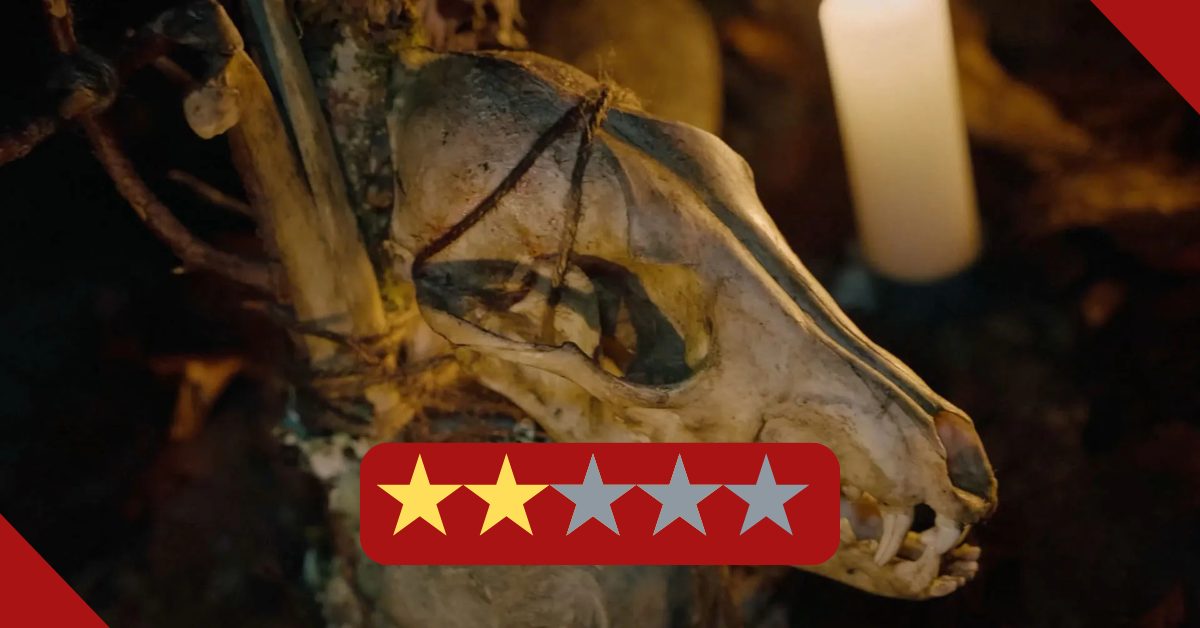
Hunting Matthew Nichols is a found-footage horror movie presented as if you’re watching a real documentary about a woman searching for her long-lost brother. Over 20 years ago, Tara Nichols’ (Miranda MacDougall) brother Matthew (James Ross) and his friend Jordan (Issiah Bullbear) disappeared without a trace, leaving behind only Matthew’s camcorder in a cabin in the woods. Given they lived on Vancouver Island, the idea Matthew and Jordan simply got lost in the deep woods was entirely plausible, and they were never found. Now his sister Tara is back with a small documentary crew (Markian Tarasiuk, Ryan Alexander McDonald) to look for him.
You might notice my summary doesn’t include any sort of ticking clock. No anniversary of the death, no maximum amount of time the documentary crew can be on the island. As far as the movie’s concerned, the Hunting Matthew Nichols crew have unlimited time and resources. Something antithetical to the idea of a documentary that exposes a coverup in a missing persons case.
What drives the plot of Hunting Matthew Nichols?
Early on in the film Tara has the documentary crew pore through all the evidence the police had for the case. Files, artifacts, and tapes from Matthew’s camcorder. The first indication this might be a horror movie is the police “forgetting” to release the tape that was in Matthew’s camcorder when they found it. A welcome addition, as up until that point it feels like a depressing drama about a woman who refuses to let go of the past.
That extra tape is a perfect encapsulation of what doesn’t particularly work with this movie. Furious about this discovery, Tara calls up her lawyer to expose the “clerical error.” The lawyer, a little too realistically, is understanding of Tara’s frustration but also points out this genuinely could have been an error. But it’ll also take “a couple months” to sort out legally.
Tara punches the wall of her motel room in frustration. The director makes awkward faces. We cut to black. A title card reads “One month later.” Tara walks into a police station and walks back out with the tape. Supposedly this team of three trying to film a documentary just sat around paying for a motel on Vancouver Island for an entire month while making no headway in their investigation, and it is never mentioned again.
What the crew finds on the tape is disturbing. So much so the footage isn’t shown directly to the audience. Instead, we’re left watching the director and Tara watch it and listen to the audio of Matthew and Jordan in the mysterious forest cabin. Something goes wrong, something seemingly supernatural happens, but Ryan and Markian privately agree it’s within the realm of possibility two movie-nerd teens in 2001 could have faked it as footage for their knockoff Blair Witch Project.
The plot of the movie seems motivated purely by the fact meta-textually it’s a horror movie, so we know something scary must happen near the end. Thus we need a series of excuses to get us to the oddly-short sequence of things becoming, y’know, horrific.
All early signs point to an incredibly rote ending where the supernatural turns out to be real, and Matthew got too close to something dangerous. Hunting Matthew Nichols even pulls the tired trick of having an older character rattle off various ancient cryptids and demonic legends before settling on something written for the movie, as if anyone who has seen more than five horror movies won’t pick up on the fact that every single time that happens in a movie the ending reveals it was one of the monsters in the middle of the list, not the one at the end.
How is the presentation?
I’m not going to sugar-coat it: the veneer of a found-footage “documentary” fades quickly when the documentary in question is presenting itself like a cheap over-polished Netflix documentary. You know the ones: tons of animated effects over people talking that betray the editor has watched one too many AfterEffects tutorials on YouTube. Lots of Storyblocks b-roll drone footage of forests to act as scene bridges. And, of course, incredibly Netflix-y dour color grading.
Some light research shows this was first shown at festivals in 2024, which gives me the impression maybe it’s gone under the editing knife a few times trying to make it into something marketable to the wider world. The trailer is incredibly specific with which quotes it uses, to the point one could easily read the film as being a conspiracy thriller about a police coverup in a small town. There’s some satanic cult that killed Matthew and they’ve got the power to simply make him disappear.
Then you show up in theaters and that is not the vibe.
It’s oddly easy to see the strings of how the movie is made, too. Characters who appear in the modern day segments of the movie almost never appear on-camera during footage supposedly from 2001. By setting the movie 20 years after the disappearance instead of 10, the filmmakers backed themselves into a corner where they can’t afford to de-age older actors or age up younger ones. As such, Tara is not present in footage from 2001. Her father appears in the past but not the present, while her mom never appears in old footage but appears quite a bit in the present. Being interviewed by Tara is basically a guarantee you won’t appear in the 2001 flashback footage.
Should I go see it?
I tried to meet this movie where it was. I really did. I don’t go into Screen Unseen or Scream Unseen presentations rubbing my hands together at my opportunity to rip a movie a new one. If I relished in talking trash about bad/problematic movies, I would’ve seen Scream 7, GOAT, and The Drama by now.
As a documentary in its own canon, it’s underwhelming and doesn’t make a good case for watching all the way through to the “scary” ending. As a fictional movie pretending to be a documentary, it is mind-boggling how much time it wastes on tropey scenes where nothing particularly happens.
During the doldrums of the middle, where I started asking when this would become a horror movie and an audience member actually fell asleep in my screening, something happened to typify the lack of effort and consistency found throughout Hunting Matthew Nichols: Tara interviews Jordan’s father Mitchell (Trevor Carroll). During this scene Carroll is given a boilerplate stoic First Nations stereotype of Old Guy Who Knows Too Much. To nail that vibe even more, Tara shares a story from childhood where she broke her arm and Jordan did Reiki hand gestures to alleviate the pain.
Nevermind the fact that Reiki is
1. A pseudoscience.
2. Not based on beliefs from First Nations tribes.
3. Created in Japan in 1922.
Mitchell nods, gives a vague explanation of how he raised Jordan to believe pain scrambles up energy and you can “untwist” it, and then hands Tara a plot-important prop. As if she’d completed a dialog tree with a quest-giver in a video game and Mitchell’s only option from that moment was to give her the thing she needs to continue the movie.


Leave a Reply