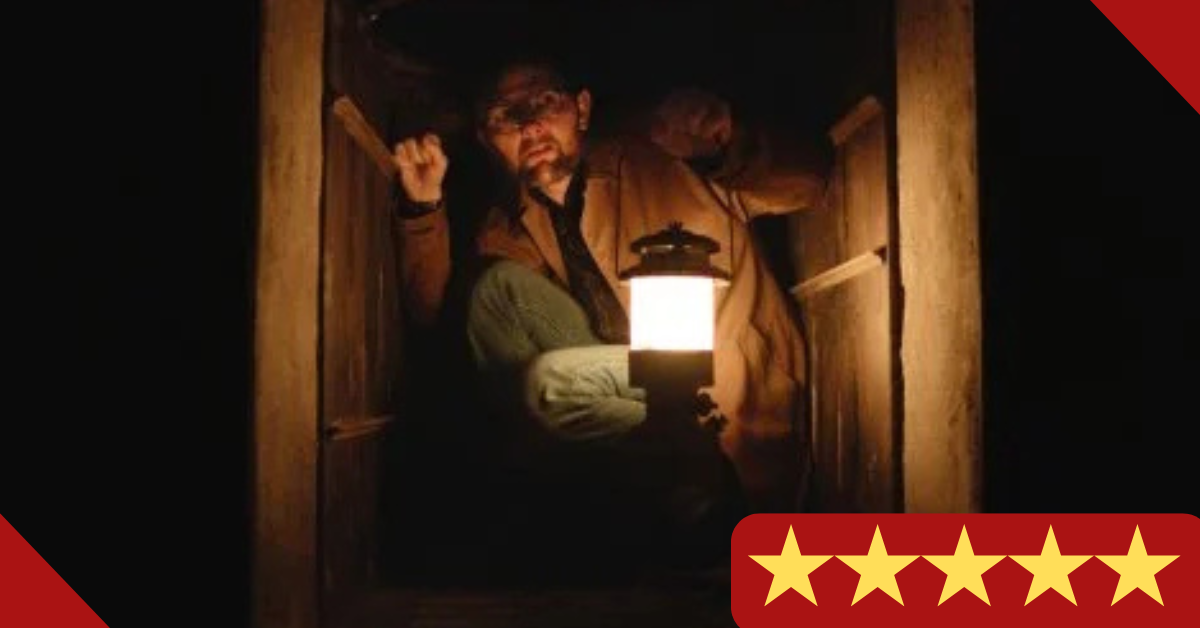
Hokum is the latest folk horror movie from Irish director Damien McCarthy, known for his previous films Oddity and Caveat. Haunted by a dark past, American author Ohm Bauman visits a rural hotel his parents honeymooned at to spread their ashes at a spot they loved. While there, he gets wrapped up in a dark secret tied to the hotel’s honeymoon suite. There’s a ghost and a witch involved, exciting stuff.
Subscribers of my YouTube channel are likely rolling their eyes right now over even more Hokum discussion. I promise I will shut up about it after this review. They’ve already seen my review from an early screening and a second video explaining how Hokum is in conversation with Oddity and Caveat. Long story short: if you enjoyed Caveat or Oddity, you’ll have a blast with Hokum.
That said, let’s dig into why Hokum has taken up residence in my head for over a week now.
Adam Scott’s Fine Line

I do not envy Adam Scott’s position as an actor in Hokum. The protagonist of the movie is a moody author with a chip on his shoulder. I know, a horror movie about a writer. Groundbreaking.
Yet Scott pulls it off. Hokum walks a razor-thin line of making Ohm a jerk with a drinking problem without losing sight of his humanity and reasons to like him. He’s thoroughly humbled, and adjusts his behavior to reckon with his past. For a dick to become a darling in a horror movie, it’s crucial that their evolution is believable and timed just right, or they’ll just magically start being a nicer person who suddenly believes in ghosts because the script needs them to.
Hokum is the former, not the latter.
The Mundanity of Ghosts

I touched on this concept in my second Hokum video, so I’ll try not to repeat too much here. Suffice it to say: I really enjoy how Hokum, and McCarthy movies in general, handle ghosts. There is a distinctly Irish sentiment to how ghosts are presented throughout his movies that vibes with me better than the ghosts just clocking in for their shift at the jumpscare-factory you find in a lot of mainstream Hollywood horror.
This approach to the supernatural trims a lot of the fat from tropes you’ve seen a hundred times. Hokum has the most “that’s preposterous, ghosts aren’t real” dialog of McCarthy’s career, but even then it’s isolated to Ohm himself, and nobody agrees with him. He’s a dickish American with some ghosts of his own (figuratively or otherwise, who’s to say?) while everyone he’s talking to is Irish and at least partially believes.
In Damien McCarthy’s ghost movies, people are less resistant to the idea of ghosts than they are to wanting to deal with the fact there’s a ghost around. While I don’t necessarily think McCarthy has intentionally made three movies in the same world, the McCarthy one-word-horror trilogy is consistent in its lack of characters refusing to believe ghosts exist. Characters in Caveat and Oddity simply don’t want a ghost to be real. The word “ghost” is used sparingly, to the point I don’t think it’s actually said out loud in Caveat.
Simple Reasons for Simple Problems

A running throughline across McCarthy’s horror trilogy is the creation of elegant, simple reasons for characters to be in danger. In Caveat, Isaac can’t simply leave the creepy cabin because he’s on an island and can’t swim. Darcy Odello in Oddity can’t simply go where she needs to because she’s blind.
Hokum establishes this McCarthy approach to danger from the very first scene. We open on a desert, following a haggard conquistador and a young boy as the conquistador follows a treasure map he keeps in a bottle. After finding a key landmark, the conquistador goes to check the map one last time and finds the bottle’s cork has pushed in too far. To get the map out, he’ll have to break the bottle.
He’s surrounded by nothing but sand. There’s nothing solid to break the bottle against. A Twilight Zone-ian level cruelty of circumstance. We cut between this realization and our protagonist Ohm Bauman sipping whiskey and typing away on a document titled EPILOGUE. Not only is the conquistador scene something he’s making up, it’s given a dark sense of finality with the fact it’s taking place in an epilogue.
The conquistador scene makes for one of the best examples of a horror movie establishing a tone I’ve seen in a good long while. There’s no monsters, it’s broad daylight. None of the characters or locations are relevant to the rest of the movie, save for their context and iconography. It’s only when the camera settles back on Ohm writing that a ghost shows up and kicks off the standard horror of the movie. I find myself thinking about the conquistador scene a lot. It works both to establish what Hokum will be like and McCarthy’s overall body of work.
Go See Hokum

I don’t have a cutesy title for this conclusion section. If you’ve read this far and you are at all interested, get some tickets and go see Hokum. I’ve spent so much time thinking and talking about this movie over the past week and a half I’m probably going to see it again on opening weekend. With Hokum, Damien McCarthy cements his position in the horror ecosystem, proving the tone he delivered in his locally-produced movies can translate over to a more mainstream production with a big-name American star.


Leave a Reply